



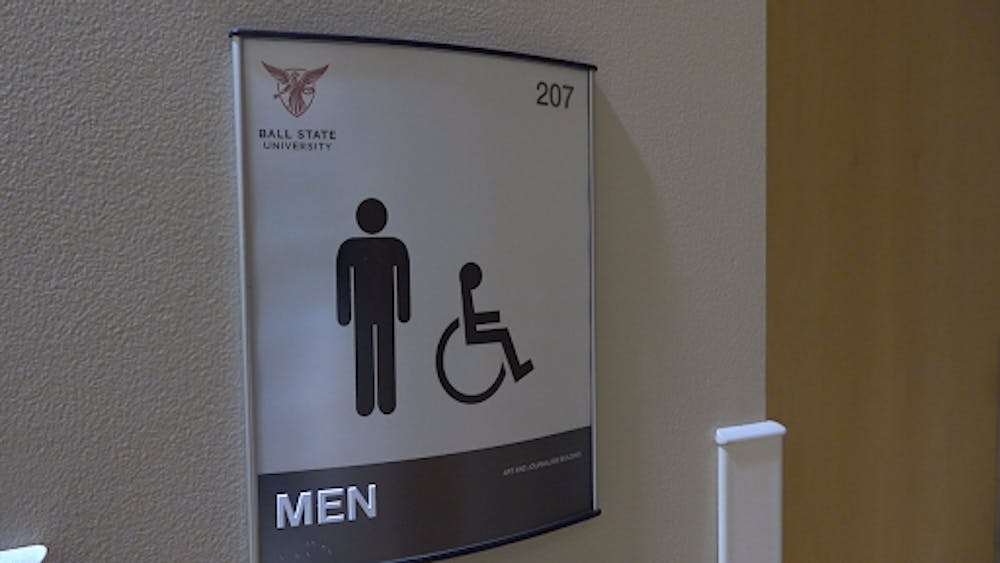
MUNCIE, Ind. — On January 28th, with a vote of 37-8, the Indianapolis Senate passed Senate Bill 182. What started as a bill to help decide the degree of security for offenders was amended to require public schools and universities to have gender exclusive areas based on sex at birth.
“So for me personally, it is an issue and a problem because it does say that someone that looks like me would have to use the women's restroom. And I think that creates a lot of uncertainty. It creates a lot of danger not only for me, but also folks across campus,” Leo Caldwell, a transgender professor at Ball State University, says, worried about the safety of members of the transgender community, and more.
To Caldwell, this could mean some members of the cis community who may have a more masculine or feminine look getting chased out of their respective restrooms. For some, however, this is a step in the right direction.
“I am more in support of it because I think that we're a family based society that not even just the nuclear family, but the extended family as well, and the family center centers around both male and female, which are biological realities and spiritual realities and are unchanging, in my opinion,” Charlie Mandziara, President of Ball State’s College Republicans, states.
If this Bill passes through the house and Governor Mike Braun, changes at Ball State University would happen soon after. To follow the proposed bill, Ball State University, as well as other schools and universities, would erase gender inclusive housing and force students to use the restrooms of their sex assigned at birth, or be subject to civil action. But these regulations pose new questions for schools and universities
“I don't know how they would enforce it, and as far as like faculty, I think faculty might be at higher risk because a lot of people know I'm trans and I'm out. So I think if you're out in public, you might be more targeted to me to have it enforced,” Caldwell says.
But enforcement might not be what is most important
“I think it's more of a I'd say in general, it's more of a symbolic law. I don't think it will be like heavily enforced,” Mandziera states.
To Mandziera, having a symbolic law that sets the biological terms in stone gives more importance than the enforcement of the proposed bill. He understands the difficulty of enforcing a law that has vast coverage, but having a few cases to give the law meaning could be what's necessary
Ball State University declined to comment on the proposed bill.
The Bill is currently in the House and will have to pass on the third reading with a majority vote before heading to Governor Braun for a final chance to pass or veto before going into law.
Contact Maxwell Robson with comments at maxwell.robson@bsu.edu.