



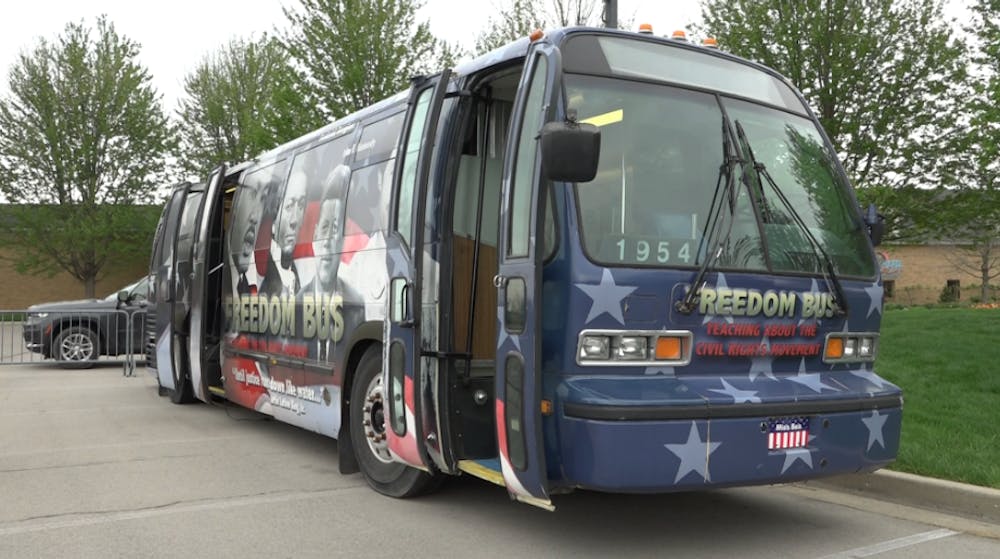
MUNCIE, Ind. - Across from the tulips and greenery at Minnetrista Museum & Gardens, there is a bus. On the side, Martin Luther King Jr., Fredrick Douglas, John F. Kennedy, and Rosa Parks welcome you aboard the Freedom Bus.
The Freedom Bus was originally a Muncie transportation bus that was transformed into a black history museum on wheels. It was created in partnership with the non-profit Martin Luther King, Jr. Dream Team, Ball State University’s Virginia B. Ball Center for Creative Inquiry, the City of Muncie, and the Muncie Human Rights Commission.
The bus gets help from Ball State Students in COMM 450, a class taught by Beth Massner, Associate Professor of Communication Studies and member of the Martin Luther King, Jr. Dream Team. One person in the class is Rosemary Papa.
“...going through all of the exhibits and actually diving into stories, like personal stories, you just really see the humanity behind it and put yourself in the shoes of, ‘Those are real people.’ ‘These are real things that happened.’ It isn't just something from our history that we gloss over.”
This year, students in the class are focusing on trying to bring awareness to the exhibit. Her role for the project was outreach. Papa said that she felt like everyone fit into their roles well.
“So, I think we all really fit into our specific roles and were really good at communicating with each other, which I’m very grateful for.” Papa said. “I would love for people to come out and see it.”
One of her classmates is Lindsey Green. Green said her favorite part of the class is working with her group and learning as they go.
“We have gone through a lot of different obstacles with what we wanted to do and how we really wanted to get people here, and I think my group has done really well of working with these obstacles and turning those challenges into making the project better and not necessarily setting us backwards.” Green said.
The Freedom Bus talks about African American history, from the Trans-Atlantic Slave Trade to the Civil Rights Movement, with a focus on the local perspective. You can hear the voices of Civil Rights leaders in East-Central Indiana and first-hand accounts from locals.
“I think there's a lot of information that people can learn about from coming onto the bus. And I think it's information that is not necessarily shared with a large group of people, and a lot of people don't necessarily know…” Green said, “And I think with how much you know and the amount of knowledge that you have only creates us to be stronger, better people that understand our community.”
Development for the Freedom Bus started in 2004. The original concept was created by Beatrice “Bea” Moten-Foster, a civil rights activist and journalist in Muncie. Due to a lack of resources, the project was in storage until 2014. The bus was finished and opened to the public in 2016, where “Miss Bea” was put on the front license plate in honor of Moten-Foster.
Beth Messner has worked closely on the Freedom Bus project and has seen it evolve over the years. A more recent development with the bus is its partnership with Minnetrista Museum & Gardens in June of last year.
“As a member of the Martin Luther King Drain team, just so thankful that Minnetrista sees value in the work that we have done as an organization, that the dozens and dozens and dozens and dozens of students have done in contributing to the project, and that they have kind of welcomed that into the fold… in terms of the educational programming that they're providing to the community.” Messner said.
Messner says her students understand the power of storytelling.
“They are students who understand that how we tell stories shapes the way we understand ourselves and understand our world. They understand the importance of using their voices to advocate for themselves and for others. and I think this group of students is very passionate about finding ways to use their skill sets.” Messner said.
Minnetrista Ceo, Brian Statz, says this bus needs to be seen.
“To me, it's important because so many people who were involved in the initial civil rights struggle, you know, in the 1950s and 60s are starting to go away. I mean, Jesse Jackson died just earlier this year. A lot of other voices are, you know, just they're growing old and eventually they'll disappear as well, unfortunately.” Statz said.
“So it's up to us today to carry on those stories. Honor what they've done in the past and the struggle that they had, but also realize that civil rights is very much a present day issue as well. And so how can we learn from them to make things better for us today, for everybody?”
The Freedom Bus is available by request during regular museum hours until June 30.
Contact Daniel Huber with comments at daniel.huber@bsu.edu.